The question isn’t only whether AI will replace advertising agencies. It’s also how we keep the human side of creative work alive. We recently got together to look at Worldcoin’s “You must be human” and “Human and you know it” campaigns. They raise an uncomfortable but interesting question: in a world full of automated content, where does the value of an idea lie?
Here’s what we talked about as a team.
The strength of words: imperfection can’t be automated
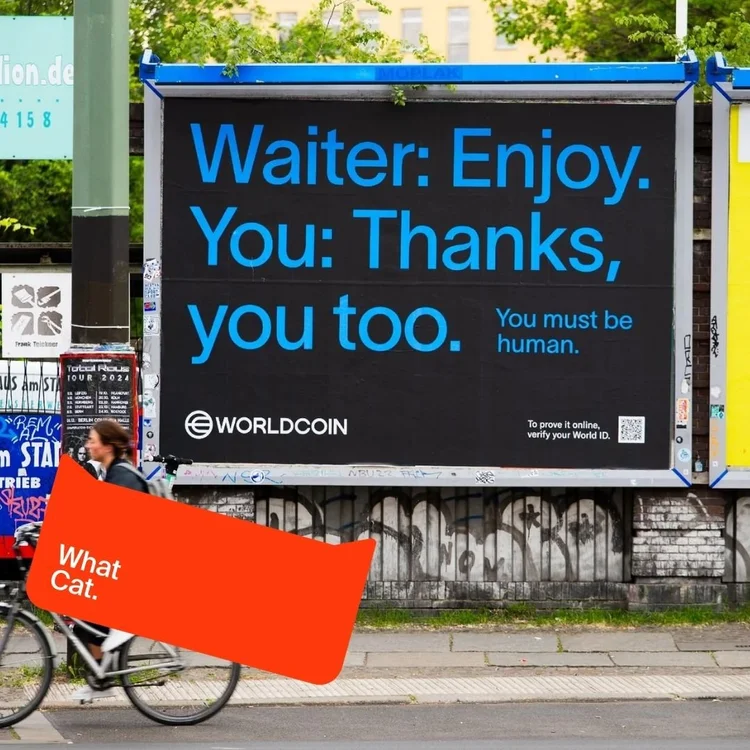
One thing that stayed with us was World’s outdoor campaign. It didn’t need hyperrealistic AI images or complicated visual effects. Just a few sentences on a plain background.
“You download Tinder. You delete Tinder. You download Tinder. You delete it again. You must be human.”
Why does it connect? It captures a contradiction, a very human loop that people recognise. AI is good at processing logical data, but advertising often draws on what isn’t logical: our mistakes. Simple, honest writing shows why human behaviour still matters to creative work. Often, we don’t need more artificial visuals. We need better stories from real life.
Our approach to AI at WhatCat. Studio
We take ethics and transparency in technology seriously. Our internal AI policy guides our day-to-day work:
A tool, not a replacement: we use AI to help with processes and brainstorming, never as a substitute for artistic talent or strategic thinking.
Privacy and intellectual property: we protect client data and make sure original creative work is properly credited.
Transparency: we explain when and how AI tools are involved in the work.
After our last discussion, though, we felt something was missing: an explicit commitment to protect and encourage the impulse to create things ourselves.
Thirty minutes with a notebook: a new habit in the studio
To put that thought into practice, we decided on a daily requirement for our creative team: thirty minutes with a notebook.
For half an hour each day, we work with pencil and paper, away from screens, to step out of the digital environment and reconnect with more hands-on ways of thinking.
Using technology to make routine tasks faster makes sense, as long as we use the time it frees up to think, feel and create.
Technology is part of the future. The point of view is human.
Words won’t lose their power because people read less or spend more time on screens. Creativity is still something people share. At WhatCat. Studio, we choose to use technology while keeping human contributions at the centre of our work.
When did you last sit down to put an idea on paper?
Watch “You must be human”: https://youtu.be/Gw_U4uH5-9g?si=O68E-oZgh9DAc2ob