
From a UX principle to clearer communication
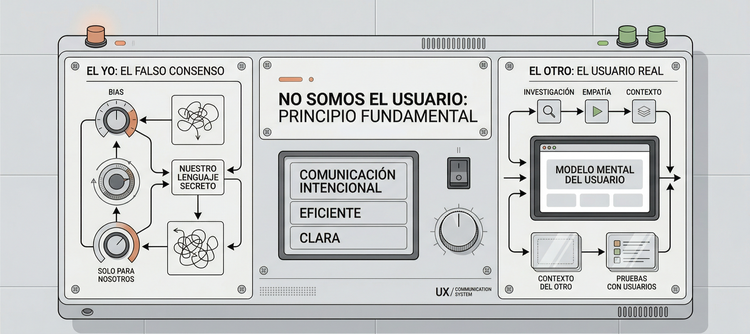
A team discussion reminded us of a basic principle of user experience: we are not the user.
The idea came up in a creativity and research class based on Raluca Budiu’s article “You Are Not the User: The False-Consensus Effect”. It asks us to create for the people who will use the work, rather than for ourselves as the supposed experts.
The false-consensus effect is one of the biggest obstacles to teamwork and communication. Understanding it pushes us beyond our own circles so that a message or design works for its actual audience.
Three points stood out to us about putting that into practice:
1. The trap of designing for ourselves
When we make something only for ourselves, we can use shorthand and skip explanations that feel obvious. Most of our work, though, is for other people. Their backgrounds, experiences, goals and ways of understanding things differ from ours.
Within a team, false consensus can lead us to assume a colleague has all the information, or that sending one message is enough. The lack of clarity creates extra work and frustration.
2. Be clear about who you’re making it for
Whether we’re designing or communicating, we miss the point if we don’t consider the other person’s perspective, be it a client’s or a colleague’s.
The way to assess whether a message is clear is to try it with actual users, rather than colleagues. We need to make systems that suit the people who will use them, not just systems we like.
The aim is to learn, not to look for approval. Confidence in the work should come from the research.
3. Choose the channel with the user in mind
This approach also means adapting the content to the audience’s circumstances. It isn’t only about working websites or eye-catching campaigns. We need to use the places where our audience already spends time and expects to hear from us.
For a campaign aimed at people aged fifteen to eighteen, LinkedIn probably wouldn’t be the main channel. Even if we use it every day as professionals, that choice wouldn’t make sense for the audience.
The key: see it from the other person’s side
An idea alone isn’t enough. We need to be open to exchange, get to know the user, colleague or client, and question our own assumptions. That helps make communication deliberate, useful and, above all, clear.